

Twitter (X)
Connect to Twitter (X). Post tweets, manage timelines, handle DMs, follow users, like content, manage lists, and upload media on behalf of your users.
Connect to Twitter (X). Post and manage tweets, read timelines, handle direct messages, manage followers, like and bookmark content, work with lists, upload media, and monitor Spaces — all on behalf of your users via OAuth 2.0 PKCE.

Supports authentication: OAuth 2.0
What you can build with this connector
| Use case | Tools involved |
|---|---|
| Automated social publishing | twitter_post_create → twitter_post_lookup (verify) |
| Audience growth agent | twitter_followers_get → twitter_user_follow → twitter_user_lookup |
| Content monitoring | twitter_recent_search → twitter_post_lookup → twitter_post_like |
| Thread composer | twitter_post_create (with reply.in_reply_to_tweet_id chain) |
| DM outreach automation | twitter_followers_get → twitter_dm_send |
| List curation agent | twitter_recent_search → twitter_list_create → twitter_list_member_add |
| Engagement tracker | twitter_post_likers_get + twitter_post_retweeters_get → aggregate stats |
| Content bookmarking | twitter_recent_search → twitter_bookmark_add |
| Spaces discovery | twitter_spaces_search → twitter_space_get → twitter_space_posts_get |
| Media-rich posting | twitter_media_upload → twitter_post_create (with media.media_ids) |
Key concepts:
- Tweet IDs: All tweet operations use numeric string IDs (e.g.,
"1234567890123456789"). Fetch IDs from search or timeline results before updating or deleting. - User fields: By default, user objects return only
id,name, andusername. Useuser.fieldsexpansions to requestprofile_image_url,description,public_metrics,verified, and more. - Tweet fields: Request extra context with
tweet.fields:author_id,created_at,public_metrics,entities,referenced_tweets. - Pagination: List endpoints return a
next_tokeninmeta. Pass it aspagination_tokento retrieve the next page. Maximum results per page is 100 for most endpoints. - Rate limits: Twitter API v2 enforces per-endpoint rate limits. The free tier allows 1 500 tweet reads and 500 tweet writes per month. Monitor
x-rate-limit-remainingresponse headers. - OAuth scopes: Each tool requires specific OAuth scopes. Ensure the connection was authorized with all required scopes before calling write operations.
- Media uploads: Images under ~5 MB can use
twitter_media_upload. For GIFs, videos, or larger files, usetwitter_media_upload_largeor the chunked flow (twitter_media_upload_init→twitter_media_upload_append→twitter_media_upload_status_get). - Authenticated user ID: Many endpoints require the authenticated user’s own ID. Use
twitter_user_meto retrieve it before calling those endpoints.
Set up the agent connector
Section titled “Set up the agent connector”Register your Twitter app credentials with Scalekit so it can manage the OAuth 2.0 authentication flow and token lifecycle on your behalf. You’ll need a Client ID and Client Secret from the Twitter Developer Portal.
-
Create a Twitter connection in Scalekit
-
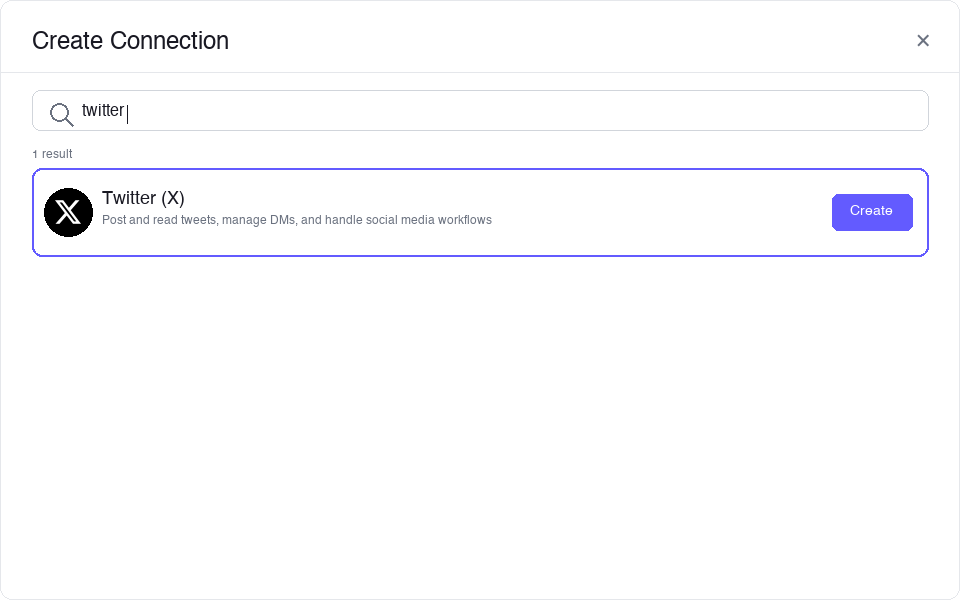
In Scalekit dashboard, go to Agent Auth → Create Connection. Search for Twitter and click Create.
-
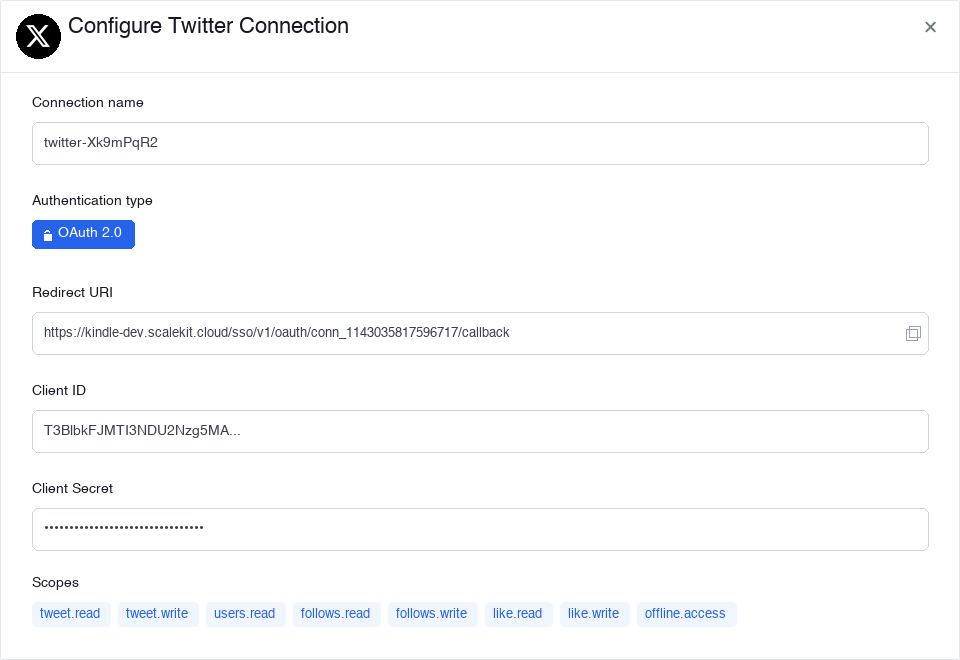
In the Configure Twitter Connection panel, copy the Redirect URI. It looks like
https://<SCALEKIT_ENVIRONMENT_URL>/sso/v1/oauth/<CONNECTION_ID>/callback. You’ll paste this into Twitter in the next step.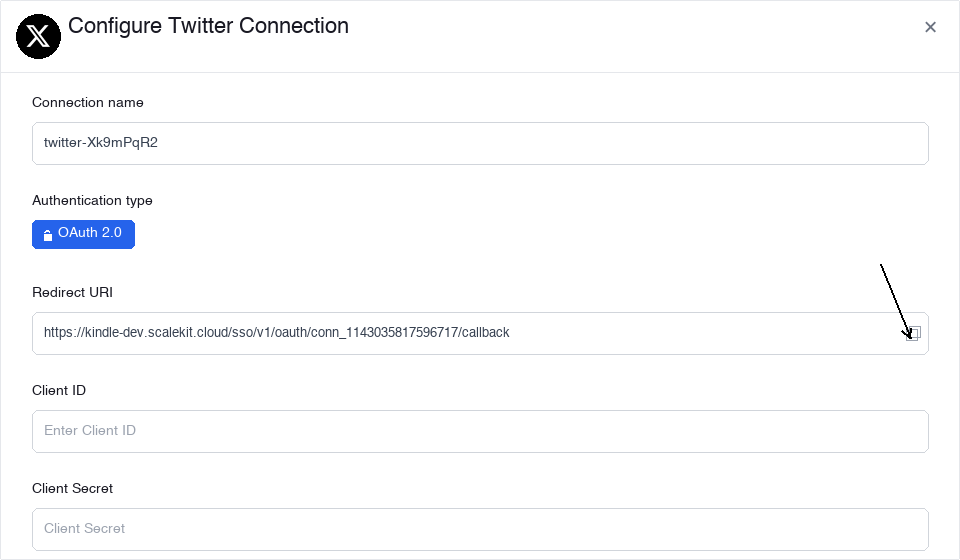
-
-
Create an app in the Twitter Developer Portal
-
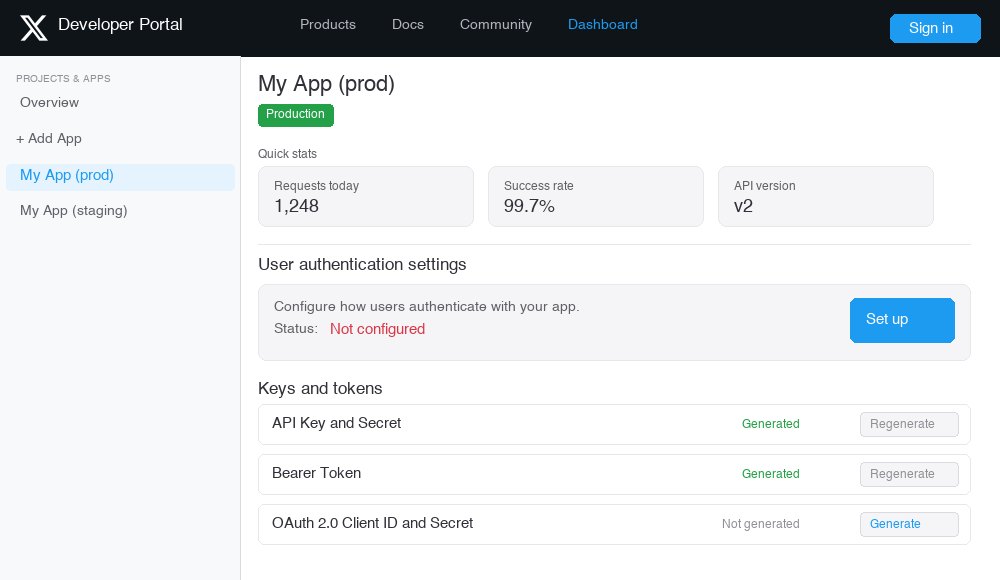
Go to the Twitter Developer Portal and sign in.
-
Click + Add App (or + Create Project to group apps by environment).
-
Select Production environment and give your app a name.
-
-
Configure user authentication settings
-
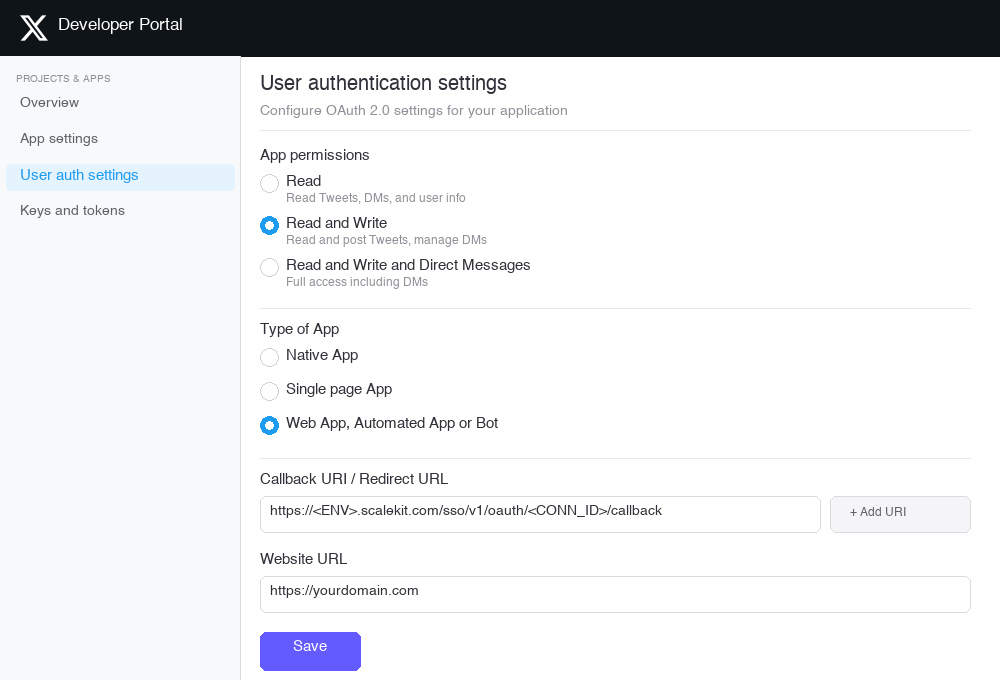
In your app’s overview, find User authentication settings and click Set up.
-
Set the following values:
Setting Value App permissions Read and Write — needed to post and manage content on behalf of users Type of App Web App, Automated App or Bot Callback URI / Redirect URL Paste the Redirect URI from Scalekit Website URL Your application’s public homepage -
Click Save.
-
-
Copy OAuth 2.0 credentials
-
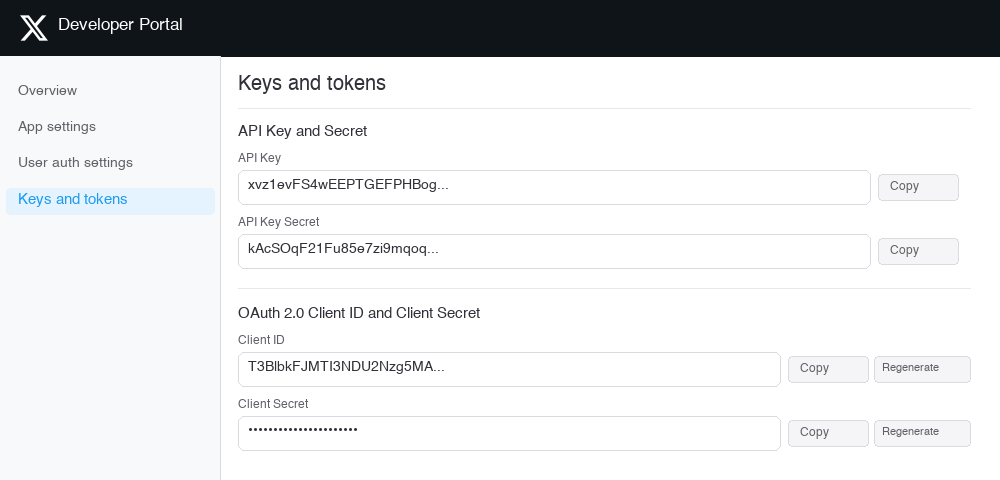
In your app, navigate to Keys and tokens.
-
Under OAuth 2.0 Client ID and Client Secret, click Generate (or Regenerate if credentials already exist).
-
Copy the Client ID and Client Secret.
-
-
Add credentials in Scalekit
-
In Scalekit dashboard, go to Agent Auth → Connections and open the Twitter connection you created.
-
Enter your credentials:
- Client ID — from the Twitter OAuth 2.0 section
- Client Secret — copied in the previous step
- Scopes — select the permissions your app needs:
tweet.read— read tweets and timelinestweet.write— create, delete, and manage tweetsusers.read— read user profile datafollows.read— read follower/following listsfollows.write— follow and unfollow userslike.read— read liked tweetslike.write— like and unlike tweetsbookmark.read— read bookmarked tweetsbookmark.write— add and remove bookmarkslist.read— read list membership and tweetslist.write— create, update, and delete listsdm.read— read direct messagesdm.write— send direct messagesmute.read— read muted usersmute.write— mute and unmute usersblock.read— read blocked usersblock.write— block and unblock usersoffline.access— obtain refresh tokens for long-lived access
-
Click Save.
-
Connect a user’s Twitter account and make API calls on their behalf — Scalekit handles OAuth 2.0 PKCE and token management automatically.
You can interact with Twitter in two ways: via direct proxy API calls or via Scalekit optimized tool calls. Scroll down to see the full list of available tools.
Proxy API calls
import { ScalekitClient } from '@scalekit-sdk/node';import 'dotenv/config';
const connectionName = 'twitter'; // connection name from Agent Auth → Connectionsconst identifier = 'user_123'; // your unique user identifier
// Get credentials from app.scalekit.com → Developers → Settings → API Credentialsconst scalekit = new ScalekitClient( process.env.SCALEKIT_ENV_URL, process.env.SCALEKIT_CLIENT_ID, process.env.SCALEKIT_CLIENT_SECRET);const actions = scalekit.actions;
// Step 1: Generate an authorization link and redirect your user to itconst { link } = await actions.getAuthorizationLink({ connectionName, identifier,});console.log('Authorize Twitter:', link);process.stdout.write('Press Enter after authorizing...');await new Promise(r => process.stdin.once('data', r));
// Step 2: Make Twitter API v2 requests via the Scalekit proxy// No token management needed — Scalekit handles refresh automaticallyconst me = await actions.request({ connectionName, identifier, path: '/2/users/me', method: 'GET', params: { 'user.fields': 'name,username,profile_image_url,description' },});console.log('Authenticated user:', me);
// Example: post a tweetconst tweet = await actions.request({ connectionName, identifier, path: '/2/tweets', method: 'POST', body: { text: 'Hello from Scalekit Agent Auth!' },});console.log('Posted tweet:', tweet);
// Example: search recent tweetsconst search = await actions.request({ connectionName, identifier, path: '/2/tweets/search/recent', method: 'GET', params: { query: 'from:twitterdev', max_results: '10' },});console.log('Search results:', search);import osimport scalekit.clientfrom dotenv import load_dotenvload_dotenv()
connection_name = "twitter" # connection name from Agent Auth → Connectionsidentifier = "user_123" # your unique user identifier
# Get credentials from app.scalekit.com → Developers → Settings → API Credentialsscalekit_client = scalekit.client.ScalekitClient( client_id=os.getenv("SCALEKIT_CLIENT_ID"), client_secret=os.getenv("SCALEKIT_CLIENT_SECRET"), env_url=os.getenv("SCALEKIT_ENV_URL"),)actions = scalekit_client.actions
# Step 1: Generate an authorization link and redirect your user to itlink_response = actions.get_authorization_link( connection_name=connection_name, identifier=identifier)print("Authorize Twitter:", link_response.link)input("Press Enter after authorizing...")
# Step 2: Make Twitter API v2 requests via the Scalekit proxyme = actions.request( connection_name=connection_name, identifier=identifier, path="/2/users/me", method="GET", params={"user.fields": "name,username,profile_image_url,description"})print("Authenticated user:", me)
# Example: post a tweettweet = actions.request( connection_name=connection_name, identifier=identifier, path="/2/tweets", method="POST", body={"text": "Hello from Scalekit Agent Auth!"})print("Posted tweet:", tweet)
# Example: search recent tweetssearch = actions.request( connection_name=connection_name, identifier=identifier, path="/2/tweets/search/recent", method="GET", params={"query": "from:twitterdev", "max_results": "10"})print("Search results:", search)Tool list
Section titled “Tool list”twitter_user_me
Section titled “twitter_user_me”Returns profile information for the currently authenticated X user. Use this to get the authenticated user’s ID before calling endpoints that require it.
| Name | Type | Required | Description |
|---|---|---|---|
user.fields | string | No | Comma-separated extra user fields: created_at, description, entities, location, pinned_tweet_id, profile_image_url, protected, public_metrics, url, verified |
expansions | string | No | Expand related objects. Use pinned_tweet_id to include the pinned tweet object. |
tweet.fields | string | No | Fields to return for expanded tweet objects. |
twitter_user_lookup
Section titled “twitter_user_lookup”Retrieves detailed public information for a Twitter user by their ID. Optionally expand related data (e.g., pinned tweets) and specify particular user or tweet fields to return.
| Name | Type | Required | Description |
|---|---|---|---|
id | string | Yes | Twitter user ID (e.g., "783214"). |
user.fields | string | No | Comma-separated extra user fields. |
expansions | string | No | Expand related objects (e.g., pinned_tweet_id). |
tweet.fields | string | No | Fields for expanded tweet objects. |
twitter_user_lookup_by_username
Section titled “twitter_user_lookup_by_username”Fetches public profile information for a valid and existing Twitter user by their username. Results may be limited for protected profiles not followed by the authenticated user.
| Name | Type | Required | Description |
|---|---|---|---|
username | string | Yes | Twitter handle without the @ prefix (e.g., "twitter"). |
user.fields | string | No | Comma-separated extra user fields. |
expansions | string | No | Expand related objects. |
tweet.fields | string | No | Fields for expanded tweet objects. |
twitter_users_lookup
Section titled “twitter_users_lookup”Retrieves detailed information for specified X user IDs. Optionally customize returned fields and expand related entities like pinned tweets.
| Name | Type | Required | Description |
|---|---|---|---|
ids | string | Yes | Comma-separated list of user IDs (max 100). |
user.fields | string | No | Comma-separated extra user fields. |
expansions | string | No | Expand related objects. |
tweet.fields | string | No | Fields for expanded tweet objects. |
twitter_users_lookup_by_username
Section titled “twitter_users_lookup_by_username”Retrieves detailed information for 1 to 100 Twitter users by their usernames (each 1–15 alphanumeric characters or underscores). Allows customizable user/tweet fields and expansion of related data.
| Name | Type | Required | Description |
|---|---|---|---|
usernames | string | Yes | Comma-separated list of Twitter usernames (max 100, without @). |
user.fields | string | No | Comma-separated extra user fields. |
expansions | string | No | Expand related objects. |
tweet.fields | string | No | Fields for expanded tweet objects. |
twitter_post_lookup
Section titled “twitter_post_lookup”Fetches comprehensive details for a single Tweet by its unique ID, provided the Tweet exists and is accessible.
| Name | Type | Required | Description |
|---|---|---|---|
id | string | Yes | The tweet ID to retrieve. |
tweet.fields | string | No | Comma-separated tweet fields: author_id, created_at, entities, public_metrics, referenced_tweets, reply_settings, source |
expansions | string | No | Expand related objects: author_id, referenced_tweets.id, attachments.media_keys |
user.fields | string | No | Fields for expanded author objects. |
media.fields | string | No | Fields for expanded media objects: url, preview_image_url, alt_text |
twitter_posts_lookup
Section titled “twitter_posts_lookup”Retrieves detailed information for one or more Posts (Tweets) identified by their unique IDs. Allows selection of specific fields and expansions.
| Name | Type | Required | Description |
|---|---|---|---|
ids | string | Yes | Comma-separated list of tweet IDs (max 100). |
tweet.fields | string | No | Comma-separated tweet fields to include. |
expansions | string | No | Expand related objects. |
user.fields | string | No | Fields for expanded user objects. |
media.fields | string | No | Fields for expanded media objects. |
twitter_post_create
Section titled “twitter_post_create”Creates a Tweet on Twitter. The text field is required unless card_uri, media_media_ids, poll_options, or quote_tweet_id is provided. Supports media, polls, geo, and reply targeting.
| Name | Type | Required | Description |
|---|---|---|---|
text | string | No* | The text content of the tweet. Maximum 280 characters. Required unless providing card_uri, media.media_ids, poll.options, or quote_tweet_id. |
reply.in_reply_to_tweet_id | string | No | Tweet ID to reply to. Creates a threaded reply. |
quote_tweet_id | string | No | Tweet ID to quote-tweet. |
reply_settings | string | No | Who can reply: mentionedUsers, following, or subscribers. Defaults to everyone. |
media.media_ids | array<string> | No | Media IDs from the Twitter media upload API to attach. |
poll.options | array<string> | No | Poll option labels (2–4 options). Must be paired with poll.duration_minutes. |
poll.duration_minutes | integer | No | Poll duration in minutes (5–10080). Required when poll.options is set. |
card_uri | string | No | Card URI for attaching a Twitter card. |
*At least one of text, card_uri, media.media_ids, poll.options, or quote_tweet_id is required.
twitter_post_delete
Section titled “twitter_post_delete”Irreversibly deletes a specific Tweet by its ID. The Tweet may persist in third-party caches after deletion.
| Name | Type | Required | Description |
|---|---|---|---|
id | string | Yes | The ID of the tweet to delete. |
twitter_post_retweet
Section titled “twitter_post_retweet”Retweets a Tweet for the authenticated user. The user ID is automatically fetched from the authenticated session — you only need to provide the tweet_id.
| Name | Type | Required | Description |
|---|---|---|---|
tweet_id | string | Yes | The ID of the tweet to retweet. |
twitter_post_unretweet
Section titled “twitter_post_unretweet”Removes a user’s retweet of a specified Post, if the user had previously retweeted it.
| Name | Type | Required | Description |
|---|---|---|---|
tweet_id | string | Yes | The ID of the tweet to un-retweet. |
twitter_post_like
Section titled “twitter_post_like”Allows the authenticated user to like a specific, accessible Tweet. The authenticated user’s ID is automatically determined from the OAuth token — you only need to provide the tweet_id.
| Name | Type | Required | Description |
|---|---|---|---|
tweet_id | string | Yes | The ID of the tweet to like. |
twitter_post_unlike
Section titled “twitter_post_unlike”Allows an authenticated user to remove their like from a specific post. The action is idempotent and completes successfully even if the post was not liked.
| Name | Type | Required | Description |
|---|---|---|---|
tweet_id | string | Yes | The ID of the tweet to unlike. |
twitter_post_likers_get
Section titled “twitter_post_likers_get”Retrieves users who have liked the Post (Tweet) identified by the provided ID.
| Name | Type | Required | Description |
|---|---|---|---|
id | string | Yes | The tweet ID whose liking users to retrieve. |
max_results | integer | No | Number of results (1–100). Defaults to 100. |
pagination_token | string | No | Token from a previous response to retrieve the next page. |
user.fields | string | No | Extra user fields to include. |
expansions | string | No | Expand related objects. |
twitter_post_retweeters_get
Section titled “twitter_post_retweeters_get”Retrieves users who publicly retweeted a specified public Post ID, excluding Quote Tweets and retweets from private accounts.
| Name | Type | Required | Description |
|---|---|---|---|
id | string | Yes | The tweet ID whose retweeters to retrieve. |
max_results | integer | No | Number of results (1–100). Defaults to 100. |
pagination_token | string | No | Token from a previous response to retrieve the next page. |
user.fields | string | No | Extra user fields to include. |
expansions | string | No | Expand related objects. |
twitter_post_retweets_get
Section titled “twitter_post_retweets_get”Retrieves Tweets that Retweeted a specified public or authenticated-user-accessible Tweet ID. Optionally customize the response with fields and expansions.
| Name | Type | Required | Description |
|---|---|---|---|
id | string | Yes | The tweet ID whose retweets to retrieve. |
max_results | integer | No | Number of results (1–100). Defaults to 100. |
pagination_token | string | No | Token from a previous response to retrieve the next page. |
tweet.fields | string | No | Tweet fields to include. |
expansions | string | No | Expand related objects. |
user.fields | string | No | Fields for expanded user objects. |
twitter_post_quotes_get
Section titled “twitter_post_quotes_get”Retrieves Tweets that quote a specified Tweet. Requires a valid Tweet ID.
| Name | Type | Required | Description |
|---|---|---|---|
id | string | Yes | The tweet ID whose quote tweets to retrieve. |
max_results | integer | No | Number of results (1–100). Defaults to 10. |
pagination_token | string | No | Token from a previous response to retrieve the next page. |
tweet.fields | string | No | Tweet fields to include. |
expansions | string | No | Expand related objects. |
user.fields | string | No | Fields for expanded user objects. |
twitter_post_analytics_get
Section titled “twitter_post_analytics_get”Retrieves analytics data for specified Posts within a defined time range. Returns engagement metrics, impressions, and other analytics. Requires OAuth 2.0 with tweet.read and users.read scopes.
| Name | Type | Required | Description |
|---|---|---|---|
tweet_ids | array<string> | Yes | List of tweet IDs to retrieve analytics for. |
start_time | string | Yes | Start of the time range. ISO 8601 format: YYYY-MM-DDTHH:MM:SSZ. |
end_time | string | Yes | End of the time range. ISO 8601 format. |
twitter_recent_search
Section titled “twitter_recent_search”Searches Tweets from the last 7 days matching a query using X’s search syntax. Ideal for real-time analysis, trend monitoring, or retrieving posts from specific users (e.g., from:username).
| Name | Type | Required | Description |
|---|---|---|---|
query | string | Yes | Search query using Twitter query syntax. Max 512 characters. Example: "from:twitter -is:retweet" |
max_results | integer | No | Number of results per page (10–100). Defaults to 10. |
pagination_token | string | No | Token from a previous response to retrieve the next page. |
start_time | string | No | Oldest UTC timestamp. ISO 8601 format. |
end_time | string | No | Newest UTC timestamp. ISO 8601 format. |
since_id | string | No | Return tweets with IDs greater than this value (newer). |
until_id | string | No | Return tweets with IDs less than this value (older). |
tweet.fields | string | No | Comma-separated tweet fields to include. |
expansions | string | No | Expand related objects: author_id, referenced_tweets.id |
user.fields | string | No | Fields for expanded author objects. |
twitter_recent_tweet_counts
Section titled “twitter_recent_tweet_counts”Retrieves the count of Tweets matching a specified search query within the last 7 days, aggregated by minute, hour, or day.
| Name | Type | Required | Description |
|---|---|---|---|
query | string | Yes | Search query using Twitter query syntax. |
granularity | string | No | Time granularity for aggregation: minute, hour, or day. Defaults to hour. |
start_time | string | No | Oldest UTC timestamp. ISO 8601 format. |
end_time | string | No | Newest UTC timestamp. ISO 8601 format. |
since_id | string | No | Count tweets newer than this tweet ID. |
until_id | string | No | Count tweets older than this tweet ID. |
twitter_full_archive_search
Section titled “twitter_full_archive_search”Searches the full archive of public Tweets from March 2006 onwards. Use start_time and end_time together for a defined time window. Requires Academic Research access.
| Name | Type | Required | Description |
|---|---|---|---|
query | string | Yes | Search query using Twitter query syntax. Max 1024 characters. |
max_results | integer | No | Number of results per page (10–500). Defaults to 10. |
next_token | string | No | Token from a previous response to retrieve the next page. |
start_time | string | No | Oldest UTC timestamp. ISO 8601 format. Cannot be used with since_id. |
end_time | string | No | Newest UTC timestamp. ISO 8601 format. Cannot be used with until_id. |
since_id | string | No | Return tweets newer than this ID. Cannot be used with start_time. |
until_id | string | No | Return tweets older than this ID. Cannot be used with end_time. |
tweet.fields | string | No | Tweet fields to include. |
expansions | string | No | Expand related objects. |
user.fields | string | No | Fields for expanded user objects. |
twitter_full_archive_search_counts
Section titled “twitter_full_archive_search_counts”Returns a count of Tweets from the full archive that match a specified query, aggregated by day, hour, or minute. start_time must be before end_time if both are provided. since_id/until_id cannot be used with start_time/end_time.
| Name | Type | Required | Description |
|---|---|---|---|
query | string | Yes | Search query using Twitter query syntax. |
granularity | string | No | Time granularity: minute, hour, or day. Defaults to hour. |
start_time | string | No | Oldest UTC timestamp. ISO 8601 format. |
end_time | string | No | Newest UTC timestamp. ISO 8601 format. |
since_id | string | No | Count tweets newer than this ID. |
until_id | string | No | Count tweets older than this ID. |
next_token | string | No | Token for pagination. |
twitter_user_timeline_get
Section titled “twitter_user_timeline_get”Retrieves the home timeline (reverse chronological feed) for the authenticated Twitter user. Returns tweets from accounts the user follows and the user’s own tweets.
| Name | Type | Required | Description |
|---|---|---|---|
id | string | Yes | The authenticated user’s own Twitter user ID. |
max_results | integer | No | Number of tweets to return (1–100). Defaults to 100. |
pagination_token | string | No | Token from a previous response to retrieve the next page. |
since_id | string | No | Return tweets newer than this tweet ID. Use for incremental polling. |
until_id | string | No | Return tweets older than this tweet ID. |
start_time | string | No | Oldest tweet creation time. ISO 8601 format. |
end_time | string | No | Newest tweet creation time. ISO 8601 format. |
exclude | string | No | Comma-separated types to exclude: retweets, replies. |
tweet.fields | string | No | Tweet fields to include. |
expansions | string | No | Expand related objects. |
user.fields | string | No | Fields for expanded user objects. |
media.fields | string | No | Fields for expanded media objects. |
twitter_user_liked_tweets_get
Section titled “twitter_user_liked_tweets_get”Retrieves Tweets liked by a specified Twitter user, provided their liked tweets are public or accessible. Requires like.read scope.
| Name | Type | Required | Description |
|---|---|---|---|
id | string | Yes | Twitter user ID whose liked tweets to retrieve. |
max_results | integer | No | Number of results (1–100). Defaults to 100. |
pagination_token | string | No | Token from a previous response to retrieve the next page. |
tweet.fields | string | No | Tweet fields to include. |
expansions | string | No | Expand related objects. |
user.fields | string | No | Fields for expanded user objects. |
twitter_followers_get
Section titled “twitter_followers_get”Retrieves a list of users who follow a specified public Twitter user ID. Requires follows.read scope.
| Name | Type | Required | Description |
|---|---|---|---|
id | string | Yes | Twitter user ID whose followers to retrieve. |
max_results | integer | No | Number of results (1–1000). Defaults to 100. |
pagination_token | string | No | Token from a previous response to retrieve the next page. |
user.fields | string | No | Extra user fields to include. |
expansions | string | No | Expand related objects. |
tweet.fields | string | No | Fields for expanded pinned tweet objects. |
twitter_following_get
Section titled “twitter_following_get”Retrieves users followed by a specific Twitter user. Allows pagination and customization of returned user and tweet data fields via expansions. Requires follows.read scope.
| Name | Type | Required | Description |
|---|---|---|---|
id | string | Yes | Twitter user ID whose following list to retrieve. |
max_results | integer | No | Number of results (1–1000). Defaults to 100. |
pagination_token | string | No | Token from a previous response to retrieve the next page. |
user.fields | string | No | Extra user fields to include. |
expansions | string | No | Expand related objects. |
tweet.fields | string | No | Fields for expanded pinned tweet objects. |
twitter_user_follow
Section titled “twitter_user_follow”Allows an authenticated user to follow another user. Results in a pending request if the target user’s tweets are protected. Requires follows.write scope.
| Name | Type | Required | Description |
|---|---|---|---|
target_user_id | string | Yes | The Twitter user ID of the account to follow. |
twitter_user_unfollow
Section titled “twitter_user_unfollow”Allows the authenticated user to unfollow an existing Twitter user, removing the follow relationship. The source user ID is automatically determined from the authenticated session. Requires follows.write scope.
| Name | Type | Required | Description |
|---|---|---|---|
target_user_id | string | Yes | The Twitter user ID of the account to unfollow. |
twitter_bookmark_add
Section titled “twitter_bookmark_add”Adds a specified, existing, and accessible Tweet to a user’s bookmarks. Success is indicated by the bookmarked field in the response. Requires bookmark.write scope.
| Name | Type | Required | Description |
|---|---|---|---|
tweet_id | string | Yes | The ID of the tweet to bookmark. |
twitter_bookmark_remove
Section titled “twitter_bookmark_remove”Removes a Tweet from the authenticated user’s bookmarks. The Tweet must have been previously bookmarked by the user for the action to have an effect. Requires bookmark.write scope.
| Name | Type | Required | Description |
|---|---|---|---|
tweet_id | string | Yes | The ID of the tweet to remove from bookmarks. |
twitter_bookmarks_get
Section titled “twitter_bookmarks_get”Retrieves Tweets bookmarked by the authenticated user. The provided User ID must match the authenticated user’s ID. Requires bookmark.read scope.
| Name | Type | Required | Description |
|---|---|---|---|
id | string | Yes | The authenticated user’s own Twitter user ID. |
max_results | integer | No | Number of results (1–100). Defaults to 100. |
pagination_token | string | No | Token from a previous response to retrieve the next page. |
tweet.fields | string | No | Tweet fields to include. |
expansions | string | No | Expand related objects. |
user.fields | string | No | Fields for expanded user objects. |
twitter_list_create
Section titled “twitter_list_create”Creates a new, empty List on X (formerly Twitter). The provided name must be unique for the authenticated user. Accounts are added separately. Requires list.write scope.
| Name | Type | Required | Description |
|---|---|---|---|
name | string | Yes | The name for the new list. |
description | string | No | A brief description of the list. |
private | boolean | No | Set to true to make the list private. Defaults to false (public). |
twitter_list_update
Section titled “twitter_list_update”Updates an existing Twitter List’s name, description, or privacy status. Requires the List ID and at least one mutable property. Requires list.write scope.
| Name | Type | Required | Description |
|---|---|---|---|
id | string | Yes | The list ID to update. |
name | string | No | New name for the list. |
description | string | No | New description for the list. |
private | boolean | No | Update the privacy setting of the list. |
twitter_list_delete
Section titled “twitter_list_delete”Permanently deletes a specified Twitter List using its ID. The list must be owned by the authenticated user. This action is irreversible. Requires list.write scope.
| Name | Type | Required | Description |
|---|---|---|---|
id | string | Yes | The list ID to delete. |
twitter_list_lookup
Section titled “twitter_list_lookup”Returns metadata for a specific Twitter List, identified by its ID. Does not return list members. Can expand the owner’s User object via the expansions parameter. Requires list.read scope.
| Name | Type | Required | Description |
|---|---|---|---|
id | string | Yes | The list ID to retrieve. |
list.fields | string | No | Extra list fields: created_at, follower_count, member_count, owner_id, private |
expansions | string | No | Expand related objects (e.g., owner_id). |
user.fields | string | No | Fields for expanded owner user objects. |
twitter_list_timeline_get
Section titled “twitter_list_timeline_get”Fetches the most recent Tweets posted by members of a specified Twitter List. Requires list.read and tweet.read scopes.
| Name | Type | Required | Description |
|---|---|---|---|
id | string | Yes | The list ID whose timeline to retrieve. |
max_results | integer | No | Number of tweets to return (1–100). Defaults to 100. |
pagination_token | string | No | Token from a previous response to retrieve the next page. |
tweet.fields | string | No | Tweet fields to include. |
expansions | string | No | Expand related objects. |
user.fields | string | No | Fields for expanded author objects. |
media.fields | string | No | Fields for expanded media objects. |
twitter_list_members_get
Section titled “twitter_list_members_get”Fetches members of a specific Twitter List, identified by its unique ID. Requires list.read scope.
| Name | Type | Required | Description |
|---|---|---|---|
id | string | Yes | The list ID whose members to retrieve. |
max_results | integer | No | Number of results (1–100). Defaults to 100. |
pagination_token | string | No | Token from a previous response to retrieve the next page. |
user.fields | string | No | Extra user fields to include. |
expansions | string | No | Expand related objects. |
twitter_list_member_add
Section titled “twitter_list_member_add”Adds a user to a specified Twitter List. The list must be owned by the authenticated user. Requires list.write scope.
| Name | Type | Required | Description |
|---|---|---|---|
id | string | Yes | The list ID to add the member to. |
user_id | string | Yes | The Twitter user ID to add as a member. |
twitter_list_member_remove
Section titled “twitter_list_member_remove”Removes a user from a Twitter List. The response is_member field will be false if removal was successful or the user was not a member. Requires list.write scope.
| Name | Type | Required | Description |
|---|---|---|---|
id | string | Yes | The list ID to remove the member from. |
user_id | string | Yes | The Twitter user ID to remove from the list. |
twitter_list_follow
Section titled “twitter_list_follow”Allows the authenticated user to follow a specific Twitter List they are permitted to access, subscribing them to the list’s timeline. This does not automatically follow individual list members. Requires list.write scope.
| Name | Type | Required | Description |
|---|---|---|---|
list_id | string | Yes | The list ID to follow. |
twitter_list_unfollow
Section titled “twitter_list_unfollow”Enables a user to unfollow a specific Twitter List, removing its tweets from their timeline and stopping related notifications. Reports following: false on success, even if the user was not initially following the list. Requires list.write scope.
| Name | Type | Required | Description |
|---|---|---|---|
list_id | string | Yes | The list ID to unfollow. |
twitter_list_pin
Section titled “twitter_list_pin”Pins a specified List to the authenticated user’s profile. The List must exist, the user must have access rights, and the pin limit (typically 5 Lists) must not be exceeded. Requires list.write scope.
| Name | Type | Required | Description |
|---|---|---|---|
list_id | string | Yes | The list ID to pin. |
twitter_list_unpin
Section titled “twitter_list_unpin”Unpins a List from the authenticated user’s profile. The user ID is automatically retrieved if not provided. Requires list.write scope.
| Name | Type | Required | Description |
|---|---|---|---|
list_id | string | Yes | The list ID to unpin. |
twitter_list_followers_get
Section titled “twitter_list_followers_get”Fetches a list of users who follow a specific Twitter List, identified by its ID. Ensure the authenticated user has access if the list is private. Requires list.read scope.
| Name | Type | Required | Description |
|---|---|---|---|
id | string | Yes | The list ID whose followers to retrieve. |
max_results | integer | No | Number of results (1–100). Defaults to 100. |
pagination_token | string | No | Token from a previous response to retrieve the next page. |
user.fields | string | No | Extra user fields to include. |
expansions | string | No | Expand related objects. |
twitter_user_owned_lists_get
Section titled “twitter_user_owned_lists_get”Retrieves Lists created (owned) by a specific Twitter user — not Lists they follow or are subscribed to. Requires list.read scope.
| Name | Type | Required | Description |
|---|---|---|---|
id | string | Yes | Twitter user ID whose owned lists to retrieve. |
max_results | integer | No | Number of results (1–100). Defaults to 100. |
pagination_token | string | No | Token from a previous response to retrieve the next page. |
list.fields | string | No | Extra list fields to include. |
expansions | string | No | Expand related objects (e.g., owner_id). |
user.fields | string | No | Fields for expanded owner user objects. |
twitter_user_followed_lists_get
Section titled “twitter_user_followed_lists_get”Returns metadata (not Tweets) for lists a specific Twitter user follows. Optionally includes expanded owner details. Requires list.read scope.
| Name | Type | Required | Description |
|---|---|---|---|
id | string | Yes | Twitter user ID whose followed lists to retrieve. |
max_results | integer | No | Number of results (1–100). Defaults to 100. |
pagination_token | string | No | Token from a previous response to retrieve the next page. |
list.fields | string | No | Extra list fields to include. |
expansions | string | No | Expand related objects. |
user.fields | string | No | Fields for expanded owner user objects. |
twitter_user_list_memberships_get
Section titled “twitter_user_list_memberships_get”Retrieves all Twitter Lists a specified user is a member of, including public Lists and private Lists the authenticated user is authorized to view. Requires list.read scope.
| Name | Type | Required | Description |
|---|---|---|---|
id | string | Yes | Twitter user ID whose list memberships to retrieve. |
max_results | integer | No | Number of results (1–100). Defaults to 100. |
pagination_token | string | No | Token from a previous response to retrieve the next page. |
list.fields | string | No | Extra list fields to include. |
expansions | string | No | Expand related objects. |
user.fields | string | No | Fields for expanded user objects. |
twitter_user_pinned_lists_get
Section titled “twitter_user_pinned_lists_get”Retrieves the Lists a specific, existing Twitter user has pinned to their profile to highlight them. Requires list.read scope.
| Name | Type | Required | Description |
|---|---|---|---|
id | string | Yes | Twitter user ID whose pinned lists to retrieve. |
list.fields | string | No | Extra list fields to include. |
expansions | string | No | Expand related objects. |
user.fields | string | No | Fields for expanded owner user objects. |
twitter_dm_send
Section titled “twitter_dm_send”Sends a new Direct Message with text and/or media to a specified Twitter user. Creates a new DM and does not modify existing messages. Media must be pre-uploaded using a media upload tool. Requires dm.write scope.
| Name | Type | Required | Description |
|---|---|---|---|
participant_id | string | Yes | The Twitter user ID of the DM recipient. |
text | string | No* | The text content of the direct message. |
media_id | string | No* | Media ID from a prior upload to attach to the message. |
*At least one of text or media_id is required.
twitter_dm_conversation_send
Section titled “twitter_dm_conversation_send”Sends a message with optional text and/or media attachments to a specified Twitter Direct Message conversation. Requires dm.write scope.
| Name | Type | Required | Description |
|---|---|---|---|
dm_conversation_id | string | Yes | The DM conversation ID to send the message to. |
text | string | No* | The text content of the message. |
media_id | string | No* | Media ID from a prior upload to attach. |
*At least one of text or media_id is required.
twitter_dm_events_get
Section titled “twitter_dm_events_get”Returns recent Direct Message events for the authenticated user, such as new messages or changes in conversation participants. Requires dm.read scope.
| Name | Type | Required | Description |
|---|---|---|---|
max_results | integer | No | Number of events to return (1–100). Defaults to 100. |
pagination_token | string | No | Token from a previous response to retrieve the next page. |
dm_event.fields | string | No | Extra DM event fields: created_at, sender_id, text, attachments |
expansions | string | No | Expand related objects: sender_id, attachments.media_keys |
user.fields | string | No | Fields for expanded participant objects. |
media.fields | string | No | Fields for expanded media objects. |
twitter_dm_conversation_events_get
Section titled “twitter_dm_conversation_events_get”Fetches Direct Message (DM) events for a one-on-one conversation with a specified participant ID, ordered chronologically newest to oldest. Does not support group DMs. Requires dm.read scope.
| Name | Type | Required | Description |
|---|---|---|---|
participant_id | string | Yes | The Twitter user ID of the conversation participant. |
max_results | integer | No | Number of events to return (1–100). Defaults to 100. |
pagination_token | string | No | Token from a previous response to retrieve the next page. |
dm_event.fields | string | No | Extra DM event fields to include. |
expansions | string | No | Expand related objects. |
twitter_dm_conversation_retrieve
Section titled “twitter_dm_conversation_retrieve”Retrieves Direct Message (DM) events for a specific conversation ID. Useful for analyzing messages and participant activities. Requires dm.read scope.
| Name | Type | Required | Description |
|---|---|---|---|
dm_conversation_id | string | Yes | The DM conversation ID to retrieve. |
max_results | integer | No | Number of events to return (1–100). Defaults to 100. |
pagination_token | string | No | Token from a previous response to retrieve the next page. |
dm_event.fields | string | No | Extra DM event fields to include. |
expansions | string | No | Expand related objects. |
twitter_dm_event_get
Section titled “twitter_dm_event_get”Fetches a specific Direct Message (DM) event by its unique ID. Allows optional expansion of related data like users or tweets. Requires dm.read scope.
| Name | Type | Required | Description |
|---|---|---|---|
event_id | string | Yes | The unique DM event ID to retrieve. |
dm_event.fields | string | No | Extra DM event fields to include. |
expansions | string | No | Expand related objects. |
user.fields | string | No | Fields for expanded user objects. |
media.fields | string | No | Fields for expanded media objects. |
twitter_dm_delete
Section titled “twitter_dm_delete”Permanently deletes a specific Twitter Direct Message (DM) event using its event_id, if the authenticated user sent it. This action is irreversible and does not delete entire conversations. Requires dm.write scope.
| Name | Type | Required | Description |
|---|---|---|---|
event_id | string | Yes | The unique DM event ID to delete. |
twitter_dm_group_conversation_create
Section titled “twitter_dm_group_conversation_create”Creates a new group Direct Message (DM) conversation on Twitter. The conversation_type must be Group. Include participant_ids and an initial message with text and optional media attachments using media_id (not media_url). Media must be uploaded first. Requires dm.write scope.
| Name | Type | Required | Description |
|---|---|---|---|
participant_ids | array<string> | Yes | List of Twitter user IDs to include in the group DM (max 49 participants plus yourself). |
text | string | No* | The initial message text for the group conversation. |
media_id | string | No* | Media ID from a prior upload to attach to the initial message. |
*At least one of text or media_id is required.
twitter_user_mute
Section titled “twitter_user_mute”Mutes a target user on behalf of an authenticated user, preventing the target’s Tweets and Retweets from appearing in the authenticated user’s home timeline without notifying the target. Requires mute.write scope.
| Name | Type | Required | Description |
|---|---|---|---|
target_user_id | string | Yes | The Twitter user ID to mute. |
twitter_user_unmute
Section titled “twitter_user_unmute”Unmutes a target user for the authenticated user, allowing them to see Tweets and notifications from the target user again. The source_user_id is automatically populated from the authenticated user’s credentials. Requires mute.write scope.
| Name | Type | Required | Description |
|---|---|---|---|
target_user_id | string | Yes | The Twitter user ID to unmute. |
twitter_muted_users_get
Section titled “twitter_muted_users_get”Returns user objects muted by the X user identified by the id path parameter. Requires mute.read scope.
| Name | Type | Required | Description |
|---|---|---|---|
id | string | Yes | The authenticated user’s own Twitter user ID. |
max_results | integer | No | Number of results (1–1000). Defaults to 100. |
pagination_token | string | No | Token from a previous response to retrieve the next page. |
user.fields | string | No | Extra user fields to include. |
expansions | string | No | Expand related objects. |
twitter_blocked_users_get
Section titled “twitter_blocked_users_get”Retrieves the authenticated user’s block list. The id parameter must be the authenticated user’s ID. Use twitter_user_me to obtain your user ID. Requires block.read scope.
| Name | Type | Required | Description |
|---|---|---|---|
id | string | Yes | The authenticated user’s own Twitter user ID. |
max_results | integer | No | Number of results (1–1000). Defaults to 100. |
pagination_token | string | No | Token from a previous response to retrieve the next page. |
user.fields | string | No | Extra user fields to include. |
expansions | string | No | Expand related objects. |
twitter_reply_visibility_set
Section titled “twitter_reply_visibility_set”Hides or unhides an existing reply Tweet. Allows the authenticated user to hide or unhide a reply to a conversation they own. You can only hide replies to posts you authored. Requires tweet.moderate.write OAuth scope.
| Name | Type | Required | Description |
|---|---|---|---|
tweet_id | string | Yes | The ID of the reply tweet to hide or unhide. |
hidden | boolean | Yes | Set to true to hide the reply, false to unhide it. |
twitter_media_upload
Section titled “twitter_media_upload”Uploads media (images only) to X/Twitter using the v2 API. Only supports images (tweet_image, dm_image) and subtitle files. For GIFs, videos, or any file larger than ~5 MB, use twitter_media_upload_large instead.
| Name | Type | Required | Description |
|---|---|---|---|
media | string | Yes | The media file content as a binary string or URL. |
media_type | string | Yes | MIME type of the media (e.g., image/jpeg, image/png). |
media_category | string | No | Category for the media: tweet_image or dm_image. |
alt_text | string | No | Accessibility description for the image. |
twitter_media_upload_base64
Section titled “twitter_media_upload_base64”Uploads media to X/Twitter using base64-encoded data. Use when you have media content as a base64 string. Only supports images and subtitle files. For videos or GIFs, use twitter_media_upload_large.
| Name | Type | Required | Description |
|---|---|---|---|
media_data | string | Yes | Base64-encoded media content. |
media_type | string | Yes | MIME type of the media (e.g., image/jpeg). |
media_category | string | No | Category for the media: tweet_image or dm_image. |
alt_text | string | No | Accessibility description for the image. |
twitter_media_upload_large
Section titled “twitter_media_upload_large”Uploads media files to X/Twitter using the v2 media upload API. Supports images, GIFs, and videos via base64-encoded data. For very large files requiring chunked upload, use twitter_media_upload_init → twitter_media_upload_append → twitter_media_upload_status_get.
| Name | Type | Required | Description |
|---|---|---|---|
media_data | string | Yes | Base64-encoded media content. |
media_type | string | Yes | MIME type of the media (e.g., video/mp4, image/gif). |
media_category | string | Yes | Category: tweet_gif, tweet_video, amplify_video, dm_gif, dm_video, tweet_image, or dm_image. |
alt_text | string | No | Accessibility description for the image. |
twitter_media_upload_init
Section titled “twitter_media_upload_init”Initializes a media upload session for X/Twitter. Returns a media_id for subsequent APPEND and FINALIZE commands. Required for uploading large files or when using the chunked upload workflow.
| Name | Type | Required | Description |
|---|---|---|---|
total_bytes | integer | Yes | Total size of the media file in bytes. |
media_type | string | Yes | MIME type of the media to upload. |
media_category | string | No | Category for the media. Determines allowed media types. |
twitter_media_upload_append
Section titled “twitter_media_upload_append”Appends a data chunk to an ongoing media upload session on X/Twitter. Use during chunked media uploads to append each segment of media data in sequence.
| Name | Type | Required | Description |
|---|---|---|---|
media_id | string | Yes | The media_id returned by twitter_media_upload_init. |
media_data | string | Yes | Base64-encoded chunk of the media data. |
segment_index | integer | Yes | Zero-based index of this chunk in the upload sequence. |
twitter_media_upload_status_get
Section titled “twitter_media_upload_status_get”Gets the status of a media upload for X/Twitter. Use to check the processing status of uploaded media, especially for videos and GIFs. Only needed if the FINALIZE command returned processing_info.
| Name | Type | Required | Description |
|---|---|---|---|
media_id | string | Yes | The media_id to check processing status for. |
twitter_space_get
Section titled “twitter_space_get”Retrieves details for a Twitter Space by its ID, allowing for customization and expansion of related data.
| Name | Type | Required | Description |
|---|---|---|---|
id | string | Yes | The Space ID to retrieve. |
space.fields | string | No | Extra space fields: created_at, creator_id, ended_at, host_ids, lang, participant_count, scheduled_start, speaker_ids, started_at, state, subscriber_count, title, topic_ids |
expansions | string | No | Expand related objects (e.g., creator_id, host_ids). |
user.fields | string | No | Fields for expanded user objects. |
twitter_spaces_get
Section titled “twitter_spaces_get”Fetches detailed information for one or more Twitter Spaces (live, scheduled, or ended) by their unique IDs. At least one Space ID must be provided.
| Name | Type | Required | Description |
|---|---|---|---|
ids | string | Yes | Comma-separated list of Space IDs (max 100). |
space.fields | string | No | Extra space fields to include. |
expansions | string | No | Expand related objects. |
user.fields | string | No | Fields for expanded user objects. |
twitter_spaces_search
Section titled “twitter_spaces_search”Searches for Twitter Spaces by a textual query. Optionally filter by state (live, scheduled, all) to discover audio conversations.
| Name | Type | Required | Description |
|---|---|---|---|
query | string | Yes | Text query to search for Spaces. |
state | string | No | Filter by state: live, scheduled, or all. Defaults to live. |
max_results | integer | No | Number of results (1–100). Defaults to 100. |
space.fields | string | No | Extra space fields to include. |
expansions | string | No | Expand related objects. |
user.fields | string | No | Fields for expanded user objects. |
twitter_spaces_by_creator_get
Section titled “twitter_spaces_by_creator_get”Retrieves Twitter Spaces created by a list of specified User IDs, with options to customize returned data fields.
| Name | Type | Required | Description |
|---|---|---|---|
user_ids | string | Yes | Comma-separated list of user IDs whose Spaces to retrieve (max 100). |
space.fields | string | No | Extra space fields to include. |
expansions | string | No | Expand related objects. |
user.fields | string | No | Fields for expanded user objects. |
twitter_space_posts_get
Section titled “twitter_space_posts_get”Retrieves Tweets that were shared/posted during a Twitter Space broadcast. Returns Tweets that participants explicitly shared during the Space session, not audio transcripts. Most Spaces have zero associated Tweets — empty results are normal.
| Name | Type | Required | Description |
|---|---|---|---|
id | string | Yes | The Space ID whose associated tweets to retrieve. |
max_results | integer | No | Number of results (1–100). Defaults to 100. |
tweet.fields | string | No | Tweet fields to include. |
expansions | string | No | Expand related objects. |
user.fields | string | No | Fields for expanded user objects. |
twitter_space_ticket_buyers_get
Section titled “twitter_space_ticket_buyers_get”Retrieves a list of users who purchased tickets for a specific, valid, and ticketed Twitter Space.
| Name | Type | Required | Description |
|---|---|---|---|
id | string | Yes | The Space ID whose ticket buyers to retrieve. |
user.fields | string | No | Extra user fields to include. |
expansions | string | No | Expand related objects. |
twitter_tweet_usage_get
Section titled “twitter_tweet_usage_get”Fetches Tweet usage statistics for a Project (e.g., consumption, caps, daily breakdowns for Project and Client Apps) to monitor API limits. Data can be retrieved for 1 to 90 days.
| Name | Type | Required | Description |
|---|---|---|---|
days | integer | No | Number of days of usage data to retrieve (1–90). Defaults to 7. |
twitter_tweet_label_stream
Section titled “twitter_tweet_label_stream”Stream real-time Tweet label events (apply/remove). Requires Enterprise access and App-Only OAuth 2.0 auth. Returns PublicTweetNotice or PublicTweetUnviewable events.
| Name | Type | Required | Description |
|---|---|---|---|
backfill_minutes | integer | No | Number of minutes of backfill data to receive on reconnect (0–5). |
twitter_compliance_job_create
Section titled “twitter_compliance_job_create”Creates a new compliance job to check the status of Tweet or user IDs. Upload IDs as a plain text file (one ID per line) to the upload_url received in the response.
| Name | Type | Required | Description |
|---|---|---|---|
type | string | Yes | Type of compliance job: tweets or users. |
name | string | No | Descriptive label for the job. |
resumable | boolean | No | Whether the upload supports resumable uploads. |
twitter_compliance_job_get
Section titled “twitter_compliance_job_get”Retrieves status, download/upload URLs, and other details for an existing Twitter compliance job specified by its unique ID.
| Name | Type | Required | Description |
|---|---|---|---|
id | string | Yes | The compliance job ID to retrieve. |
twitter_compliance_jobs_list
Section titled “twitter_compliance_jobs_list”Returns a list of recent compliance jobs, filtered by type (tweets or users) and optionally by status.
| Name | Type | Required | Description |
|---|---|---|---|
type | string | Yes | Type of compliance jobs to retrieve: tweets or users. |
status | string | No | Filter by job status: created, in_progress, failed, complete. |
twitter_activity_subscription_create
Section titled “twitter_activity_subscription_create”Creates a subscription for an X activity event. Use when you need to monitor specific user activities like profile updates, follows, or Spaces events.
| Name | Type | Required | Description |
|---|---|---|---|
event_type | string | Yes | The activity event type to subscribe to. |
user_id | string | No | The Twitter user ID to monitor for activity events. |
twitter_openapi_spec_get
Section titled “twitter_openapi_spec_get”Fetches the OpenAPI specification (JSON) for Twitter’s API v2. Used to programmatically understand the API’s structure for developing client libraries or tools. Takes no parameters.