

Vercel
Connect to Vercel. Access user profile, teams, projects, deployments, and environment settings.
Connect to Vercel. Access user profile, teams, projects, deployments, and environment settings.

Supports authentication: OAuth 2.0
Set up the agent connector
Section titled “Set up the agent connector”Register your Scalekit environment with the Vercel connector so Scalekit handles the OAuth flow and token lifecycle for your users. Follow every step below from start to finish — by the end you will have a working connection.
-
Create a Vercel OAuth integration
You need a Vercel OAuth integration to get the Client ID and Client Secret that Scalekit will use to authorize your users.
Go to the Vercel Integrations Console:
-
Open vercel.com/dashboard/integrations/console in your browser and sign in.
-
Click Create Integration (top right of the page).
-
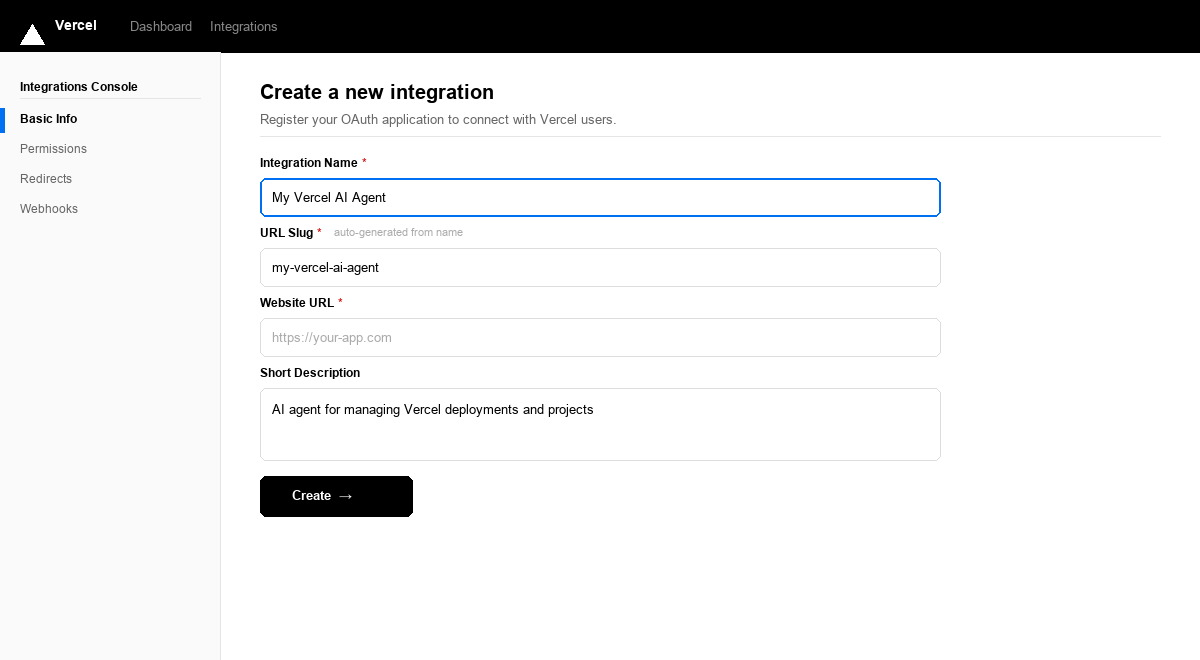
Fill in the form:
Field What to enter Integration Name A recognizable name, e.g. My Vercel AI AgentURL Slug Auto-generated from the name — you can leave it as-is Website URL Your app’s public URL. For testing you can use https://localhostShort Description Brief description of your integration -
Leave the Redirects section empty for now. You will add the Scalekit callback URL in the next step.
-
Click Create →.
After the integration is created, Vercel takes you to the integration’s settings page. Keep this tab open.
-
-
Copy the redirect URI from Scalekit
Scalekit gives you a callback URL that Vercel will redirect users back to after they authorize your app. You need to register this URL in your Vercel integration.
In the Scalekit dashboard:
- Go to app.scalekit.com and sign in.
- In the left sidebar, click Agent Auth.
- Click Create Connection.
- Search for Vercel and click Create.
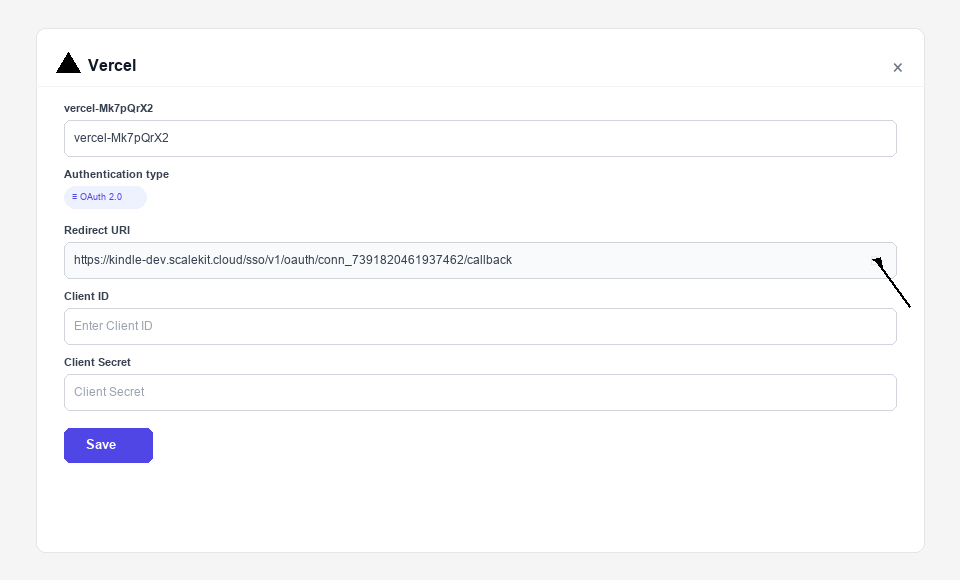
- A connection details panel opens. Find the Redirect URI field — it looks like:
https://<YOUR_ENV>.scalekit.cloud/sso/v1/oauth/conn_<ID>/callback
- Click the copy icon next to the Redirect URI to copy it to your clipboard.
-
Add the redirect URI and copy credentials from Vercel
Switch back to the Vercel integration tab you left open.
Register the redirect URI:
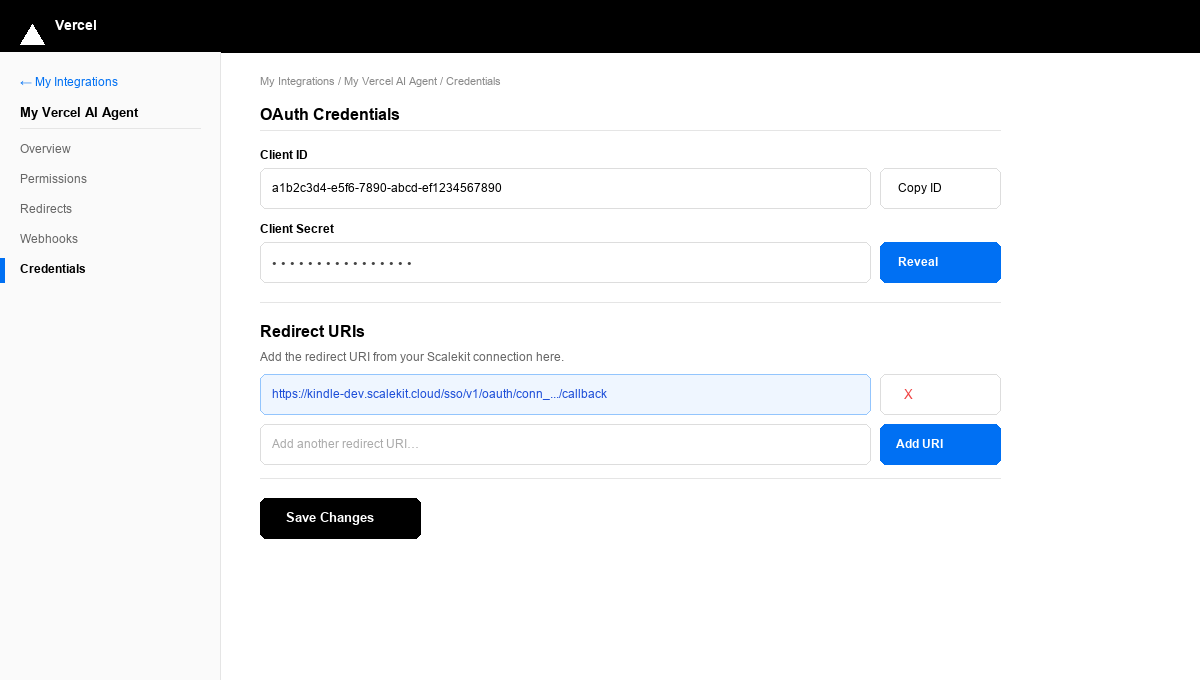
- In the left sidebar of your integration settings, click Credentials.
- Scroll down to the Redirect URIs section.
- Paste the redirect URI you copied from Scalekit into the input field.
- Click Add URI — the URI appears highlighted in the list.
- Click Save Changes.
Copy your credentials:
- Scroll up to the OAuth Credentials section.
- Client ID — shown in plain text. Click Copy ID to copy it.
- Client Secret — click Reveal to show the secret, then copy it.
Paste both values somewhere safe (a password manager or secrets vault). You will enter them into Scalekit in the next step.
-
Configure permissions in Vercel
Permissions (scopes) control which Vercel API resources your integration can access on behalf of the user.
-
In the Vercel integration settings sidebar, click Permissions.
-
Enable the scopes your integration needs:
Scope Access granted openidRequired to issue an ID token for user identification emailUser’s email address profileUser’s name, username, and profile picture offline_accessRefresh token for long-lived access without re-authorization -
Click Save Changes.
-
-
Add credentials in Scalekit
Switch back to the Scalekit dashboard tab.
-
Go to Agent Auth → Connections and click the Vercel connection you created in Step 2.
-
Fill in the credentials form:
Field Value Client ID Paste the Client ID from Step 3 Client Secret Paste the Client Secret from Step 3 Scopes Enter the scopes you enabled in Step 4, e.g. openid profile email offline_access -
Click Save.
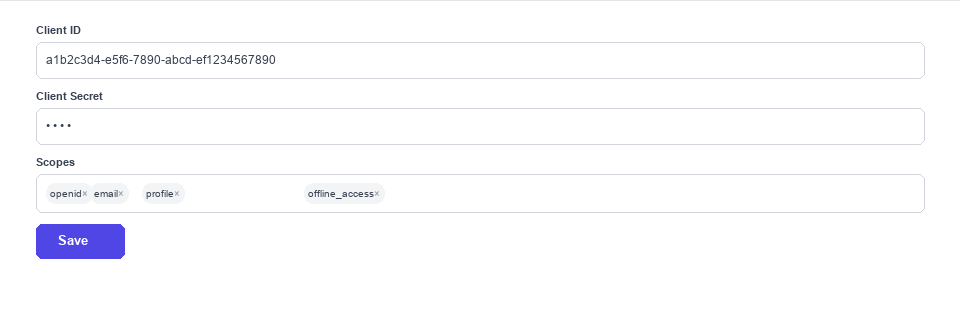
Your Vercel connection is now configured. Scalekit will use these credentials to run the OAuth flow whenever a user connects their Vercel account.
-
Connect a user’s Vercel account and make API calls on their behalf — Scalekit handles OAuth and token management automatically.
You can interact with Vercel in two ways — via direct proxy API calls or via Scalekit optimized tool calls. Scroll down to see the list of available Scalekit tools.
Proxy API calls
import { ScalekitClient } from '@scalekit-sdk/node';import 'dotenv/config';
const connectionName = 'vercel'; // get your connection name from connection configurationsconst identifier = 'user_123'; // your unique user identifier
// Get your credentials from app.scalekit.com → Developers → Settings → API Credentialsconst scalekit = new ScalekitClient( process.env.SCALEKIT_ENV_URL, process.env.SCALEKIT_CLIENT_ID, process.env.SCALEKIT_CLIENT_SECRET);const actions = scalekit.actions;
// Authenticate the userconst { link } = await actions.getAuthorizationLink({ connectionName, identifier,});console.log('Authorize Vercel:', link);process.stdout.write('Press Enter after authorizing...');await new Promise(r => process.stdin.once('data', r));
// Make a request via Scalekit proxyconst result = await actions.request({ connectionName, identifier, path: '/v2/user', method: 'GET',});console.log(result);import scalekit.client, osfrom dotenv import load_dotenvload_dotenv()
connection_name = "vercel" # get your connection name from connection configurationsidentifier = "user_123" # your unique user identifier
# Get your credentials from app.scalekit.com → Developers → Settings → API Credentialsscalekit_client = scalekit.client.ScalekitClient( client_id=os.getenv("SCALEKIT_CLIENT_ID"), client_secret=os.getenv("SCALEKIT_CLIENT_SECRET"), env_url=os.getenv("SCALEKIT_ENV_URL"),)actions = scalekit_client.actions
# Authenticate the userlink_response = actions.get_authorization_link( connection_name=connection_name, identifier=identifier)# present this link to your user for authorization, or click it yourself for testingprint("Authorize Vercel:", link_response.link)input("Press Enter after authorizing...")
# Make a request via Scalekit proxyresult = actions.request( connection_name=connection_name, identifier=identifier, path="/v2/user", method="GET")print(result)Scalekit tools
Tool list
Section titled “Tool list”vercel_alias_create
Section titled “vercel_alias_create”Assigns an alias (custom domain) to a Vercel deployment.
| Name | Type | Required | Description |
|---|---|---|---|
alias | string | Yes | The alias hostname to assign. |
deployment_id | string | Yes | The deployment ID to assign the alias to. |
team_id | string | No | Team ID if the deployment belongs to a team. |
vercel_alias_delete
Section titled “vercel_alias_delete”Removes an alias from a Vercel deployment.
| Name | Type | Required | Description |
|---|---|---|---|
alias_or_id | string | Yes | The alias hostname or ID to delete. |
team_id | string | No | Team ID if the alias belongs to a team. |
vercel_alias_get
Section titled “vercel_alias_get”Returns information about a specific alias by its ID or hostname.
| Name | Type | Required | Description |
|---|---|---|---|
alias_or_id | string | Yes | The alias hostname or ID. |
team_id | string | No | Team ID if the alias belongs to a team. |
vercel_aliases_list
Section titled “vercel_aliases_list”Returns all aliases for the authenticated user or team, with optional domain and deployment filtering.
| Name | Type | Required | Description |
|---|---|---|---|
domain | string | No | Filter aliases by domain. |
limit | integer | No | Maximum number of aliases to return. |
since | integer | No | Timestamp in ms for pagination. |
team_id | string | No | Team ID to list aliases for. |
vercel_check_create
Section titled “vercel_check_create”Creates a new check on a Vercel deployment. Used by integrations to report status of external checks like test suites or audits.
| Name | Type | Required | Description |
|---|---|---|---|
blocking | boolean | Yes | If true, this check must pass before deployment is considered ready. |
deployment_id | string | Yes | The deployment ID to create a check for. |
detailsUrl | string | No | URL where users can view check details. |
name | string | Yes | Display name for the check. |
team_id | string | No | Team ID if the deployment belongs to a team. |
vercel_check_update
Section titled “vercel_check_update”Updates the status and conclusion of a deployment check. Used to report check results back to Vercel.
| Name | Type | Required | Description |
|---|---|---|---|
check_id | string | Yes | The check ID to update. |
conclusion | string | No | Check conclusion: succeeded, failed, skipped, canceled. |
deployment_id | string | Yes | The deployment ID the check belongs to. |
detailsUrl | string | No | URL where users can view check details. |
status | string | No | Check status: running, completed. |
team_id | string | No | Team ID if the deployment belongs to a team. |
vercel_checks_list
Section titled “vercel_checks_list”Returns all checks attached to a Vercel deployment (e.g. from third-party integrations).
| Name | Type | Required | Description |
|---|---|---|---|
deployment_id | string | Yes | The deployment ID to list checks for. |
team_id | string | No | Team ID if the deployment belongs to a team. |
vercel_deployment_aliases_list
Section titled “vercel_deployment_aliases_list”Returns all aliases assigned to a specific Vercel deployment.
| Name | Type | Required | Description |
|---|---|---|---|
deployment_id | string | Yes | The deployment ID to get aliases for. |
team_id | string | No | Team ID if the deployment belongs to a team. |
vercel_deployment_cancel
Section titled “vercel_deployment_cancel”Cancels a Vercel deployment that is currently building or queued.
| Name | Type | Required | Description |
|---|---|---|---|
deployment_id | string | Yes | The deployment ID to cancel. |
team_id | string | No | Team ID if the deployment belongs to a team. |
vercel_deployment_create
Section titled “vercel_deployment_create”Creates a new Vercel deployment for a project, optionally from a Git ref or with inline files.
| Name | Type | Required | Description |
|---|---|---|---|
git_source | string | No | JSON object with Git source info, e.g. {"type":"github","ref":"main","repoId":"123"}. |
name | string | Yes | The project name to deploy. |
target | string | No | Deployment target: production or preview. Default is preview. |
team_id | string | No | Team ID if deploying to a team project. |
vercel_deployment_delete
Section titled “vercel_deployment_delete”Deletes a Vercel deployment by its ID.
| Name | Type | Required | Description |
|---|---|---|---|
deployment_id | string | Yes | The deployment ID to delete. |
team_id | string | No | Team ID if the deployment belongs to a team. |
vercel_deployment_events_list
Section titled “vercel_deployment_events_list”Returns build log events for a Vercel deployment. Useful for debugging build errors.
| Name | Type | Required | Description |
|---|---|---|---|
deployment_id | string | Yes | The deployment ID to get events for. |
limit | integer | No | Maximum number of log events to return. |
since | integer | No | Timestamp in ms to fetch events after. |
team_id | string | No | Team ID if the deployment belongs to a team. |
vercel_deployment_get
Section titled “vercel_deployment_get”Returns details of a specific Vercel deployment by its ID or URL, including build status, target, and metadata.
| Name | Type | Required | Description |
|---|---|---|---|
id_or_url | string | Yes | The deployment ID (dpl_xxx) or deployment URL. |
team_id | string | No | Team ID if the deployment belongs to a team. |
vercel_deployments_list
Section titled “vercel_deployments_list”Returns a list of deployments for the authenticated user or a specific project/team, with filtering and pagination.
| Name | Type | Required | Description |
|---|---|---|---|
from | integer | No | Timestamp in ms for pagination cursor. |
limit | integer | No | Maximum number of deployments to return. |
project_id | string | No | Filter deployments by project ID or name. |
state | string | No | Filter by deployment state: BUILDING, ERROR, INITIALIZING, QUEUED, READY, CANCELED. |
target | string | No | Filter by target environment: production or preview. |
team_id | string | No | Filter deployments by team ID. |
vercel_dns_record_create
Section titled “vercel_dns_record_create”Creates a new DNS record for a domain managed by Vercel. Supports A, AAAA, CNAME, TXT, MX, SRV, and CAA records.
| Name | Type | Required | Description |
|---|---|---|---|
domain | string | Yes | The domain to create the DNS record for. |
mx_priority | integer | No | Priority for MX records. |
name | string | Yes | Subdomain name, or empty string for root domain. |
team_id | string | No | Team ID if the domain belongs to a team. |
ttl | integer | No | Time-to-live in seconds. Default is 60. |
type | string | Yes | Record type: A, AAAA, CNAME, TXT, MX, SRV, CAA. |
value | string | Yes | The record value (IP address, hostname, text, etc.). |
vercel_dns_record_delete
Section titled “vercel_dns_record_delete”Deletes a DNS record from a domain managed by Vercel.
| Name | Type | Required | Description |
|---|---|---|---|
domain | string | Yes | The domain the DNS record belongs to. |
record_id | string | Yes | The ID of the DNS record to delete. |
team_id | string | No | Team ID if the domain belongs to a team. |
vercel_dns_records_list
Section titled “vercel_dns_records_list”Returns all DNS records for a domain managed by Vercel.
| Name | Type | Required | Description |
|---|---|---|---|
domain | string | Yes | The domain to list DNS records for. |
limit | integer | No | Maximum number of records to return. |
since | integer | No | Timestamp in ms for pagination. |
team_id | string | No | Team ID if the domain belongs to a team. |
vercel_domain_add
Section titled “vercel_domain_add”Adds a domain to the authenticated user or team’s Vercel account.
| Name | Type | Required | Description |
|---|---|---|---|
name | string | Yes | The domain name to add. |
team_id | string | No | Team ID to add the domain to. |
vercel_domain_delete
Section titled “vercel_domain_delete”Removes a domain from the authenticated user or team’s Vercel account.
| Name | Type | Required | Description |
|---|---|---|---|
domain | string | Yes | The domain name to delete. |
team_id | string | No | Team ID if the domain belongs to a team. |
vercel_domain_get
Section titled “vercel_domain_get”Returns information about a specific domain including verification status, nameservers, and registrar.
| Name | Type | Required | Description |
|---|---|---|---|
domain | string | Yes | The domain name to look up. |
team_id | string | No | Team ID if the domain belongs to a team. |
vercel_domains_list
Section titled “vercel_domains_list”Returns all domains registered or added to the authenticated user or team’s Vercel account.
| Name | Type | Required | Description |
|---|---|---|---|
limit | integer | No | Maximum number of domains to return. |
since | integer | No | Timestamp in ms for pagination. |
team_id | string | No | Team ID to list domains for. |
vercel_edge_config_create
Section titled “vercel_edge_config_create”Creates a new Edge Config store for storing read-only configuration data close to users at the edge.
| Name | Type | Required | Description |
|---|---|---|---|
slug | string | Yes | A unique slug for the Edge Config store. |
team_id | string | No | Team ID to create the Edge Config under. |
vercel_edge_config_delete
Section titled “vercel_edge_config_delete”Permanently deletes an Edge Config store and all its items.
| Name | Type | Required | Description |
|---|---|---|---|
edge_config_id | string | Yes | The Edge Config store ID to delete. |
team_id | string | No | Team ID if the Edge Config belongs to a team. |
vercel_edge_config_get
Section titled “vercel_edge_config_get”Returns details of a specific Edge Config store by its ID.
| Name | Type | Required | Description |
|---|---|---|---|
edge_config_id | string | Yes | The Edge Config store ID. |
team_id | string | No | Team ID if the Edge Config belongs to a team. |
vercel_edge_config_item_get
Section titled “vercel_edge_config_item_get”Returns the value of a specific item from an Edge Config store by key.
| Name | Type | Required | Description |
|---|---|---|---|
edge_config_id | string | Yes | The Edge Config store ID. |
item_key | string | Yes | The key of the item to retrieve. |
team_id | string | No | Team ID if the Edge Config belongs to a team. |
vercel_edge_config_items_list
Section titled “vercel_edge_config_items_list”Returns all key-value items stored in an Edge Config store.
| Name | Type | Required | Description |
|---|---|---|---|
edge_config_id | string | Yes | The Edge Config store ID. |
team_id | string | No | Team ID if the Edge Config belongs to a team. |
vercel_edge_config_items_update
Section titled “vercel_edge_config_items_update”Creates, updates, or deletes items in an Edge Config store using a list of patch operations.
| Name | Type | Required | Description |
|---|---|---|---|
edge_config_id | string | Yes | The Edge Config store ID. |
items | string | Yes | JSON array of patch operations. Each item has ‘operation’ (create/update/upsert/delete), ‘key’, and optionally ‘value’. |
team_id | string | No | Team ID if the Edge Config belongs to a team. |
vercel_edge_config_token_create
Section titled “vercel_edge_config_token_create”Creates a new read token for an Edge Config store to be used in application code.
| Name | Type | Required | Description |
|---|---|---|---|
edge_config_id | string | Yes | The Edge Config store ID. |
label | string | Yes | A descriptive label for the token. |
team_id | string | No | Team ID if the Edge Config belongs to a team. |
vercel_edge_config_tokens_delete
Section titled “vercel_edge_config_tokens_delete”Deletes one or more read tokens from an Edge Config store.
| Name | Type | Required | Description |
|---|---|---|---|
edge_config_id | string | Yes | The Edge Config store ID. |
team_id | string | No | Team ID if the Edge Config belongs to a team. |
tokens | string | Yes | JSON array of token IDs to delete. |
vercel_edge_config_tokens_list
Section titled “vercel_edge_config_tokens_list”Returns all read tokens for an Edge Config store.
| Name | Type | Required | Description |
|---|---|---|---|
edge_config_id | string | Yes | The Edge Config store ID. |
team_id | string | No | Team ID if the Edge Config belongs to a team. |
vercel_edge_configs_list
Section titled “vercel_edge_configs_list”Returns all Edge Config stores for the authenticated user or team.
| Name | Type | Required | Description |
|---|---|---|---|
team_id | string | No | Team ID to list Edge Configs for. |
vercel_env_var_create
Section titled “vercel_env_var_create”Creates a new environment variable for a Vercel project with the specified key, value, and target environments.
| Name | Type | Required | Description |
|---|---|---|---|
id_or_name | string | Yes | The project ID or name. |
key | string | Yes | The environment variable key. |
target | string | No | JSON array of targets: production, preview, development. Defaults to all. |
team_id | string | No | Team ID if the project belongs to a team. |
type | string | No | Variable type: plain or secret. Default is plain. |
value | string | Yes | The environment variable value. |
vercel_env_var_delete
Section titled “vercel_env_var_delete”Deletes an environment variable from a Vercel project.
| Name | Type | Required | Description |
|---|---|---|---|
env_id | string | Yes | The environment variable ID to delete. |
id_or_name | string | Yes | The project ID or name. |
team_id | string | No | Team ID if the project belongs to a team. |
vercel_env_var_update
Section titled “vercel_env_var_update”Updates an existing environment variable for a Vercel project.
| Name | Type | Required | Description |
|---|---|---|---|
env_id | string | Yes | The environment variable ID to update. |
id_or_name | string | Yes | The project ID or name. |
target | string | No | JSON array of new targets: production, preview, development. |
team_id | string | No | Team ID if the project belongs to a team. |
value | string | No | New value for the environment variable. |
vercel_env_vars_list
Section titled “vercel_env_vars_list”Returns all environment variables for a Vercel project, including their targets (production, preview, development) and encryption status.
| Name | Type | Required | Description |
|---|---|---|---|
decrypt | boolean | No | If true, returns decrypted values for sensitive variables. |
id_or_name | string | Yes | The project ID or name. |
team_id | string | No | Team ID if the project belongs to a team. |
vercel_project_create
Section titled “vercel_project_create”Creates a new Vercel project with a given name, framework, and optional Git repository.
| Name | Type | Required | Description |
|---|---|---|---|
framework | string | No | Framework preset, e.g. nextjs, vite, gatsby, nuxtjs, create-react-app. |
git_repository | string | No | JSON object with ‘type’ (github/gitlab/bitbucket) and ‘repo’ (owner/name) fields. |
name | string | Yes | The name of the project. |
root_directory | string | No | Root directory of the project within the repository. |
team_id | string | No | Team ID to create the project under. |
vercel_project_delete
Section titled “vercel_project_delete”Permanently deletes a Vercel project and all its deployments, domains, and environment variables.
| Name | Type | Required | Description |
|---|---|---|---|
id_or_name | string | Yes | The project ID or name to delete. |
team_id | string | No | Team ID if the project belongs to a team. |
vercel_project_domain_add
Section titled “vercel_project_domain_add”Assigns a domain to a Vercel project with an optional redirect target.
| Name | Type | Required | Description |
|---|---|---|---|
git_branch | string | No | Git branch to associate this domain with for preview deployments. |
id_or_name | string | Yes | The project ID or name. |
name | string | Yes | The domain name to assign to the project. |
redirect | string | No | Redirect target domain if this domain should redirect. |
team_id | string | No | Team ID if the project belongs to a team. |
vercel_project_domain_delete
Section titled “vercel_project_domain_delete”Removes a domain assignment from a Vercel project.
| Name | Type | Required | Description |
|---|---|---|---|
domain | string | Yes | The domain name to remove from the project. |
id_or_name | string | Yes | The project ID or name. |
team_id | string | No | Team ID if the project belongs to a team. |
vercel_project_domains_list
Section titled “vercel_project_domains_list”Returns all domains assigned to a specific Vercel project.
| Name | Type | Required | Description |
|---|---|---|---|
id_or_name | string | Yes | The project ID or name. |
production | boolean | No | Filter to production domains only. |
team_id | string | No | Team ID if the project belongs to a team. |
vercel_project_get
Section titled “vercel_project_get”Returns details of a specific Vercel project including its framework, Git repository, environment variables summary, and domains.
| Name | Type | Required | Description |
|---|---|---|---|
id_or_name | string | Yes | The project ID or name. |
team_id | string | No | Team ID if the project belongs to a team. |
vercel_project_update
Section titled “vercel_project_update”Updates a Vercel project’s name, framework, build command, output directory, or other settings.
| Name | Type | Required | Description |
|---|---|---|---|
build_command | string | No | Custom build command override. |
framework | string | No | Framework preset to apply. |
id_or_name | string | Yes | The project ID or name to update. |
install_command | string | No | Custom install command override. |
name | string | No | New project name. |
output_directory | string | No | Custom output directory override. |
team_id | string | No | Team ID if the project belongs to a team. |
vercel_projects_list
Section titled “vercel_projects_list”Returns all projects for the authenticated user or team, with optional search and pagination.
| Name | Type | Required | Description |
|---|---|---|---|
from | integer | No | Timestamp in ms for pagination cursor. |
limit | integer | No | Maximum number of projects to return. |
search | string | No | Filter projects by name search query. |
team_id | string | No | Team ID to list projects for. Omit for personal projects. |
vercel_team_create
Section titled “vercel_team_create”Creates a new Vercel team with the specified slug and optional name.
| Name | Type | Required | Description |
|---|---|---|---|
name | string | No | Display name for the team. |
slug | string | Yes | A unique URL-friendly identifier for the team. |
vercel_team_delete
Section titled “vercel_team_delete”Permanently deletes a Vercel team and all its associated resources.
| Name | Type | Required | Description |
|---|---|---|---|
team_id | string | Yes | The team ID or slug to delete. |
vercel_team_get
Section titled “vercel_team_get”Returns details of a specific Vercel team by its ID or slug.
| Name | Type | Required | Description |
|---|---|---|---|
team_id | string | Yes | The team ID or slug. |
vercel_team_member_invite
Section titled “vercel_team_member_invite”Invites a user to a Vercel team by email address with a specified role.
| Name | Type | Required | Description |
|---|---|---|---|
email | string | Yes | Email address of the user to invite. |
role | string | No | Role to assign: OWNER, MEMBER, VIEWER, DEVELOPER, BILLING. |
team_id | string | Yes | The team ID or slug. |
vercel_team_member_remove
Section titled “vercel_team_member_remove”Removes a member from a Vercel team by their user ID.
| Name | Type | Required | Description |
|---|---|---|---|
team_id | string | Yes | The team ID or slug. |
user_id | string | Yes | The user ID of the member to remove. |
vercel_team_members_list
Section titled “vercel_team_members_list”Returns all members of a Vercel team including their roles and join dates.
| Name | Type | Required | Description |
|---|---|---|---|
limit | integer | No | Maximum number of members to return. |
role | string | No | Filter by role: OWNER, MEMBER, VIEWER, DEVELOPER, BILLING. |
since | integer | No | Timestamp in ms to fetch members joined after this time. |
team_id | string | Yes | The team ID or slug. |
vercel_team_update
Section titled “vercel_team_update”Updates a Vercel team’s name, slug, description, or other settings.
| Name | Type | Required | Description |
|---|---|---|---|
description | string | No | New description for the team. |
name | string | No | New display name for the team. |
slug | string | No | New URL-friendly slug for the team. |
team_id | string | Yes | The team ID or slug to update. |
vercel_teams_list
Section titled “vercel_teams_list”Returns all teams the authenticated user belongs to, with pagination support.
| Name | Type | Required | Description |
|---|---|---|---|
limit | integer | No | Maximum number of teams to return. |
since | integer | No | Timestamp in milliseconds to fetch teams created after this time. |
until | integer | No | Timestamp in milliseconds to fetch teams created before this time. |
vercel_user_get
Section titled “vercel_user_get”Returns the authenticated user’s profile including name, email, username, and account details.
vercel_webhook_create
Section titled “vercel_webhook_create”Creates a new webhook that sends event notifications to the specified URL for Vercel deployment and project events.
| Name | Type | Required | Description |
|---|---|---|---|
events | string | Yes | JSON array of event types to subscribe to, e.g. [“deployment.created”,“deployment.succeeded”]. |
project_ids | string | No | JSON array of project IDs to scope this webhook to. Omit for all projects. |
team_id | string | No | Team ID to create the webhook for. |
url | string | Yes | The HTTPS endpoint URL to receive webhook payloads. |
vercel_webhook_delete
Section titled “vercel_webhook_delete”Permanently deletes a Vercel webhook.
| Name | Type | Required | Description |
|---|---|---|---|
team_id | string | No | Team ID if the webhook belongs to a team. |
webhook_id | string | Yes | The webhook ID to delete. |
vercel_webhook_get
Section titled “vercel_webhook_get”Returns details of a specific Vercel webhook by its ID.
| Name | Type | Required | Description |
|---|---|---|---|
team_id | string | No | Team ID if the webhook belongs to a team. |
webhook_id | string | Yes | The webhook ID. |
vercel_webhooks_list
Section titled “vercel_webhooks_list”Returns all webhooks configured for the authenticated user or team.
| Name | Type | Required | Description |
|---|---|---|---|
team_id | string | No | Team ID to list webhooks for. |